|
|
|
Sophistication ...,
Enfer pédagogique ...,
Global Justice ...,
Americans Less Safe Than Ever Before ...,
Angels of Peru ...,
"Tips and Tales of a Vagabond" ...,
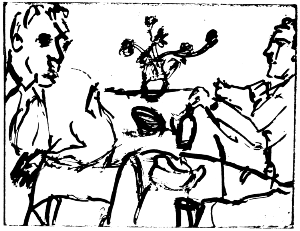
My Art in "Iconoclast" ...,
Ambassador Bissett's Speech ...,
"Finizia's Spirit and Roses" ...,
Study of "war crises" ...
(From an exchange in a Philosophy group)
"What is sophistication?" When the focus shifts from the
collective to the individual ...
"sophistication in art is particularly expressed in two branches: erotic poetry and poetry for children."
I would think those two forms couldn't get too sophisticated, otherwise the audience would lose the thread of the story.
"Both express feelings and in feelings sophistication manifests spontaneously, without alteration through intellect, intention, or tradition."
But! doesn't sophistication mean: "To cause to become less natural, especially to make less naive and more worldly."? I don't see how one can become sophisticated without being altered in some way. Perhaps we need your definition of sophistication.
You are right, I overlooked the original meaning of 'sophistication' which was the art of argument. The goal of the sophists was not so much to enlighten as to win through intellectual skirmishes. I was too absorbed in my own interest in sophistication, meaning in the field of feelings which earned their emphasis with the coming of Romanticism and Psychology. Sophistication of feelings is as different from sophistication of reasoning as feeling and reasoning are different from each other. Sophistication of feelings is a union of individuals, not a war of individuals. In sophistication of feelings, dominance doesn't play a role. But it's not a hippy-style anonymous collective love or a Buddhist style empathy but, on the contrary, it is an imprint of the individual on the collective. The group vibrates as the sum of individuals not as a melting pot of individuals. Therefore I call it an evolutionary trend. WM
Ils sont trente dans la classe, et semblent s'amuser follement en répétant après moi: "This house is big. It is a big house!". Lorsque j'enchaîne en expliquant la signification de cette phrase, je les entends répéter: "Plèè ouaa baane nii yaille. Penne baane yaille!". "Non, non, je suis votre professeur d'anglais, pas de thaï! Ne répétez pas quand je vous parle thaï, vous savez tous le thaï mieux que moi! Me comprennent-t-ils? Je ne sais pas, les Thaïs me saisissent généralement quand je parodie leur langue, et me félicitent souvent parce que je parle moins mal que la majorité des autres visages pâles vivant ici, mais ils n'auraient jamais la malpolitesse de me dire "je ne comprends pas!"
Il y a maintenant trois semaines que j'enseigne dans cette école privée de Kampaeng Phet, une ville située à 400 kilomètres au Nord de Bangkok. J'ai été engagé après avoir rencontré la directrice par le plus grand des hasards. J'ai accepté sans hésiter, j'étais sans emploi. Le fait que l'anglais ne soit pas ma langue maternelle est largement compensé, dans l'esprit de mes nouveaux collègues, par le fait que je parle thaï, même mal.
Mais la tâche qui m'attend est colossale. Les élèves thaïlandais sont d'une passivité désespérante, qui vient d'un système pédagogique absolument déplorable un désastre absolu!
Les petits Thaïs apprennent l'alphabet latin, prononcé à l'anglaise, avant d'avoir cinq ans, en même temps que le "Go gaï", l'alphabet thaï (Moi-même, je n'ai appris l'alphabet latin qu'à sept ans!). Ils savent aussi, à cinq ans, compter jusqu'à dix, que "cat" veut dire chat et "dog" chien. Alors que quand j'étais gosse, les élèves suisses romands n'apprenaient leur première langue étrangère qu'à partir de 12 ans.
Le hic, c'est que sous ces latitudes, on enseigne l'anglais de la manière dont on enseigne parfois la prière dans certaines religions: il s'agit de répéter des mots sans forcément les comprendre. Les enfants récitent des phrases du type: "the grass is green", comme s'il était important de savoir dire que l'herbe est verte quand on n'arrive même pas à comprendre une question comme "How old are you?". Et si, après s'être fait expliquer que cela signifie "quel âge as-tu?", on ne trouve rien de mieux à répondre que: "kaao kouap!" (neuf ans en thaï). Les manuels de langue sont horribles, ils comportent des erreurs de grammaire charmantes, mais inacceptables. Quand aux tests, ce sont généralement des questions à choix multiples d'une simplicité effarante. Les profs font tout pour éviter que leurs chers élèves aient de mauvaises notes. Et le fond du problème, c'est que les profs d'anglais thaïlandais sont parfois incapables de mener une conversation simple dans la langue qu'ils enseignent.
Face à une telle catastrophe pédagogique, je ne sais pas encore si je vais réussir à faire parler les charmants bambins qui m'entourent. Mais je crois avoir réussi à me faire aimer d'eux, ce qui est déjà quelque chose.
Il me faudra de la patience... Vendredi dernier, je m'étais attardé un peu avec une classe, ce qui fait que je suis arrivé en retard pour la classe suivante. La prof d'anglais qui enseigne avec moi a donc jugé bon d'occuper les élèves en attendant ma venue. (il y a presque toujours un prof thaïlandais à mes côtés quand j'enseigne. Ils maintiennent la discipline, traduisent parfois, et, surtout... apprennent un peu!).
Pour occuper les mioches, elle leur a demandé de recopier une page de leur manuel dans leur cahier. La page en question comportait... une liste d'imitation de cris d'animaux! Les cochons anglais font oink, oink, alors que les moutons font baa, baa! Et une enseignante diplômée leur demandait de retenir ça!
C'était le bouquet! Je ne sais si je vais supporter longtemps encore une telle philosophie de l'enseignement.
Ludwin
ludwin@redpin.com
Greetings and warm regards.
I have written a book. I have established a web site. Both focus on global issues - the book focuses on law around the world - the web site on issues of global justice. I thought a bit, reminisced, then decided to share my thoughts.
<...>
"Learn the law" is my cathartic global and humourous analysis of my profession - the law. The book is at once a teacher, and a release valve; however, it analyses the international legal issues concerning the war in Iraq, and expresses genuine concerns. It states what the law is and simultaneously explains what law does in the world. It traces from whence law came into the world. There is wit and humour in the book, coupled with the good sense of using tones of parody and paradox to help readers discover for themselves without the pedantry of the writer telling intelligent people what to think. This approach explains the book's subtitle - ' a retarded text for advanced readers'.
There you have it - my reminiscences - and my pot of global law as stew for thought, and all the global issues as spice to maintain flavour.
Courtenay Barnett
ablec2000@yahoo.co.uk
www.globaljusticeonline.com and "Learn the Law" - my reminiscences
Why do Americans still support him? Aren't you worried about being thrown into this chaotic region -- no Osama to capture -- and don't you wonder what would happen if there were a real threat? Does it worry you that a pee wee country like North Korea is double daring us?
Afghanistan is a mess. No promises were kept there. Iraq is a mess and it seems to be a big surprise to the U.S. which is now asking the UN to help clean up the mess.
America was more powerful when it loomed as a mighty threat. Small countries were never sure what the U.S. might do if pushed too far. And now? The U.S., throwing about a billion dollars per day into this war, is starting to creak, starting to question how far it can stretch the military. These are not the desperate glory days of World War Two when young American men emptied their towns and cities to enlist in the fight for freedom. Some Americans are already showing impatience and yet they continue to tolerate a President whose speeches repeat robotically "make no mistake" and "we will hunt them down."
Sylvia T.
sylvia_t@earthling.net
After 10 days in Peru I report that all news about this country is wrong. Although the same people who damaged Poland so much (Soros, Sachs, Balcerowicz & Co.) have moved in here as friends and advisors of president Enrique Toledo, his popularity is only 9% and he is not going to last much longer. Even illiterate taxi drivers know that he is a traitor along with his unpopular foreign born wife Eliana Karp. The main causes of the economic crisis are as old as Peru itself as Peruvians much like Poles have not had much luck electing good leaders.
But I do not want to talk about the politics of Peru but about the people who survive one crisis after another and nothing seems to affect their vitality. I will also tell you about angels of Peru, who fly over this God forsaken country spreading happiness and hope.
First story: Few weeks ago in the coastal town of Trujillo, a woman named Tula passed away. <...> During the mass, only a few understood what this woman did to deserve such a large crowd, who accompanied her all the way to cemetery.
<...> When faced with terminal illness, she refused to get depressed. Instead she converted into a silent angel helping ill and poor, without telling them even her name.
<...>
Second story: Determined and crazy with love for the poor like all Irish, the nun of Immaculate Convent offers incredible social assistance to the people. <...> Now in the mountains of Mache she has established a first quality lamb farm for poor people to work and make money.
<...>Where to find dollars? Sometimes it comes from the angels like an American engineer Jerry Fickel, who forgot that in Miami he suffers from heart dysfunction. Here in Peru he walks miles climbing tall mountains and even teaches genetics to obtain best quality of the wool and meat. He gives hope in this miserable and forgotten part of the world where not long ago most people wanted to emigrate.
Third story: One year ago when I heard that 135 wood homes burnt out in the poor section of Iquitos, I ordered my restaurant to serve them 1000 meals a day, for 10 days. <...> During my visit to Iquitos the leaders of this community asked me to meet with the community so that the people could thank me for what I did. During the meeting one of the young leaders named Roger asked me to help procure a first aid kit. Others have asked that 4 people be trained in my restaurant. They said they would pray for me to have luck.
The same day I was returning home late in the night and on the way I stopped in a local casino. I changed $10 and in 10 minutes much to my amazement I won $500 playing the slots. That was enough to cover the cost of a substantial first aid kit. Angels have helped again.
Upon return to my office in Canada I contacted the Canadian Embassy and I found two assistance programs available to poor communities in Peru. <...>. In Canada, we have many Social Service Programs, Unemployment Insurance, Medical Insurance, etc. But in Peru these tasks are covered by family and friends. When I see in Peru a true and spectacular solidarity of the people in times of need, I feel proud that I am also Peruvian. <...>
Stan Tyminski
stan@maloca.com
The Call of the Road
Chances are, you've felt the call of the road at some point. It's called me for as long as I can recall. The call of the road is irresistible and though I've tried to fight it, I'm powerless to hold it at bay. I am seduced by the desire to see what lies beyond the bend or over the ridge.
Rough living requires little, but a few things make your life a whole lot better. The first thing you absolutely have to have is a will to live. The sheer desire to survive. The will to live comes in many forms. Curiosity has kept this cat alive through some desperate times. For me, there is a need to know what is going to happen next. I have friends that have made it because they love their families. Still others live to fulfill some religious devotion. The important thing is that you refuse to die. Even when it seems like that would be the easiest course. Absolute refusal.
If you want to die, you won't survive a week of rough living. There are far too many ways to end up dead. So, first of all, if you want to learn some of the lessons and experience some of the joys of rough living, you need to want to live. If you have that, the rest is a matter of personal preference.
--from Rough Living: Tips and Tales of a Vagabond available at http://www.booklocker.com/books/1097.html
Chris Damitio
chrisdamitio@yahoo.com
http://www.geocities.com/rough_living
With great pleasure I present here my art contribution to the literary magazine "Iconoclast". WM
Editor and Publisher: Phil Wagner. Address: The Iconoclast, 1675 Amazon Road, Mohegan Lake, NY USA, 10547-1804

This text is long for the Communication Page but Ambassador Bissett demolishes the wall of lies in this extremely important correction of History. WM
VIDOVDAN SPEECH NIAGARA FALLS 29 JUNE 2003
Honored guests ladies and gentlemen:
I want at the outset to thank Bora Dragasevich for inviting me to speak to you this afternoon. It is a privilege and a sincere honor for me to be with you and to share your Vidovdan celebrations.
I recall that it was thirteen summers ago that I set off to Belgrade to take up my post as the Canadian Ambassador to Yugoslavia. Yugoslavia was then a strong and united country- more prosperous than most of the Eastern Bloc countries. Yet there were emerging signs of trouble. Urged on by the former Central Powers - Germany, Austria and Hungary - Slovenia and Croatia were already planning to separate from the Yugoslav Federation.
I became an eyewitness to the subsequent violence and break up of the country. I also was a witness to the "historical amnesia" suffered by the political leaders of France, Britain, the United States and my own country, Canada. These countries were Serbia's old traditional allies in two world wars yet they shamefully stood by and joined in the betrayal of Yugoslavia.
The break up of Yugoslavia was a disaster for the Serbian people. Thousands killed and many more thousands forced to flee their ancestral homelands. Serbs have been humiliated and many have lost their self-respect. Yet the greatest tragedy of all is that the Serbs have been blamed for everything that has happened since the breakup. They have been blamed for the breakup itself. They have been blamed for starting the violence. They have been blamed for the ethnic cleansing that occurred. They have been blamed for the massacres. They have been blamed for genocide. Finally they have been blamed for the NATO bombing of their own country!
These are lies! Lies! Lies! Hitler's propaganda Minister Joseph Goebbels said if you tell a monstrous lie people will believe you because they cannot imagine anyone making up such an outrageous falsehood. Then if evidence is shown to contradict the lie, you dismiss it as irrelevant or misguided. Finally when the truth finally is disclosed it is too late. Nobody cares or wants to know. So it has been with the dreadful lies told about the Serbs.
President Clinton and Tony Blair talked about genocide taking place in Kosovo. The US Secretary of Defense, William Cohen, said there were over a hundred thousand young Albanian men missing in Kosovo. Robin Cook the British Foreign Minister and Clare Short his cabinet colleague both made outrages charges against the Serbs about non-existent rape camps. Later it was reported by the UNHCR and even the anti-Serb, Soro's NGO, Human Rights Watch, that these stories had no foundation. Can you believe that these two hypocritical British Cabinet Ministers actually resigned over the war against Iraq!
However, there is a striking difference between Kosovo and Iraq. Despite all of Milosevic's faults he didn't compare with Saadam Hussein. Milosevic, after all, obeyed all of the UN Resolutions - including allowing troops from the Organization for European Cooperation and Development [OECD] into Kosovo. He was no threat to his neighbors. He did not aspire to, nor did he possess, weapons of mass destruction. Although not a democrat he was not a psychopathic killer like Saadam nor was Serbia under his regime a totalitarian state, as was Iraq. In reality he was trying to suppress an armed rebellion in his own territory- a rebellion led by a Muslim terrorist organization - and for this the NATO countries bombed his country.
I believe now that it is generally accepted by most of the informed public in the West [with the exception of the main stream media in Canada and the United States] that the bombing of Yugoslavia was deliberately contrived. It served as a means of providing NATO with a reason for existence and President Clinton with a distraction from his sexual embarrassments. The truth is gradually emerging from a variety of reliable sources. One of the most revealing has been the admission by the former British Defense Minister, Lord Gilbert, who told the British House of Commons in July 2000 that the terms forced upon Milosevic at Rambouillet were deliberately designed to provoke war.
So the truth is slowly coming out. Regretfully it is too late in itself to restore to many Serbs their sense of pride and self-respect. This is left to you as a people. However, knowing you as I do- and mindful of your historic courage and heroism - I am confident you will overcome this historic setback as you have done before. The main thing is to ensure that your young people remain proud of their heritage and do not accept the simplistic and biased accounts of the North American media's account of the Yugoslav breakup.
I want to end my speech today on a positive note. There are, believe it or not, some encouraging signs of reconciliation and hope in the former Yugoslavia. A recent agreement signed in Lake Ohrid by representatives of five Balkan countries: Serbia/Montenegro, Croatia, Macedonia, Bosnia-Herzegovina and Albania will translate, if all goes well, into a free trade agreement to become effective in 2007. Moreover, Croatia and Serbia/Montenegro have agreed to declare both countries "visa free" so that citizens of each country can travel back and forth without visas. There is even some hope that under EU pressure property rights might be restored to those who have been displaced by the wars.
The driving force behind these positive developments is of course the European Union. The incentive for these countries to forget their ancient hatreds and to conform to so-called Western values of free markets and democratization is the carrot to becoming members of the EU Club. In the final analysis geography and economics may well conquer Balkan politics. The circle will become closed - and once again in a different form - the former Yugoslavia will emerge.
I will conclude on this upbeat note but not before adding a personal warning. The history of Serbia has recorded heroic victories and terrible defeats. The victories have come when Serbs have relied on their own resources and inner strengths. The defeats have come when their allies have betrayed them or let them down. There is a lesson here that you must not forget. Do not put all of your trust or faith in others, especially in multilateral organizations or in politicians. And remember history does sometimes repeat itself. You ought never to forget this. Who could have imagined that the horrors that took place in the spring and summer of 1941in Croatia and Bosnia would repeat themselves in the 1990's?
James Bissett [former Canadian Ambassador to Yugoslavia 1990-1992.]
Dear Mr. Markiewicz,
a friend of mine send me the nice WEB page with the painting Finizia's Spirit & Roses, which is really beautiful.
My name is Finizia, and it is a very rare name, traditionally passed from gran Ma' (from part of the father) to the first niece, in my family. It is more common as a family name rather than a person name. So, I am courious to know about the origin of this painting, since there are not so many woman in the world called Finizia. What is the story of this painting?
Thank you for your attention
Best regards
Finizia Auriemma
Associate Professor of Industrial Chemistry
University of Napoli Federico II
Napoli
Indeed it is a family name. Riccardo Finizia is an Italian-Canadian sculptor and I called my still life "Finizia's Spirit" because I feel that in this work he expresses the spirit of the land, of its stone, of its First Nations. It's very interesting to learn that the name 'Finizia' is also a first name. Thanks for your interest, I'm sure that Riccardo will send you invitations to future exhibits. WM
http://archive.vagabondpages.com/gallery/ImageS13.htmlWe at the Independent Institute have just launched a new website, OnPower.org, dedicated to the study of the growth and span of government and the bureaucratic fallout of "war crises."
OnPower.org is a program of the Independent Institute's Center on Peace & Liberty, directed by Ivan Eland and founded to study the war on terrorism, the war in Iraq, civil liberties and other post 9-11 war-related issues.
OnPower.org is broken down into four categories:
...Crises and power (civil liberties, constitution and Bill of Rights,
corporate welfare, culture, defense, economy, government power and
politics);
...History (Civil War, progressive era, World War I, Great Depression,
World War II, Cold War, Gulf Wars and war on terrorism);
...Foreign Policy (blowback, development and aid, intelligence,
interventionism, non-interventionism, protectionism and the regional
influence of Africa, Asia, Europe, Latin America, the Middle East and
North America; and
...Over 450 quotes over government power by authors, scholars and
political leaders.
Valerie Walston
Public Affairs Director
http://www.independent.org
 Back to the index of the Vagabond
 William Markiewicz