About Wilek's Art
This review appeared in the Polish language, Toronto-based,
High Park magazine, issue 12
The work under my hand becomes a work of art when it starts to speak
to me in a language I didn't know before but which I understand.
William Markiewicz
FOLLOWING THE LIGHT
by Ewa Chwojko
The fallen giant silently cries his defeat. Lost in sorrow, there is
only him and his suffering. An undisturbed world. One more giant falls
but his fall does not disturb the silence of the bouquet in the window,
doesn't cover the green fence with its shadow. In the works of William
Markiewicz -- known in Toronto art circles as 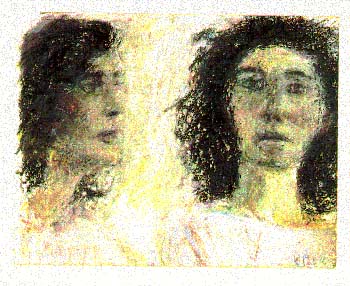 'Wilek'
--- the drama of the giant fits naturally somewhere in between the peace
of the courtyard seen through a flowering bush and the sleepy melancholy
of the lady with the doll. Crumbs of existence caught in form and colour.
Inimitable elements of some mysterious unity; impenetrable. Accessible
only in small glimpses.
'Wilek'
--- the drama of the giant fits naturally somewhere in between the peace
of the courtyard seen through a flowering bush and the sleepy melancholy
of the lady with the doll. Crumbs of existence caught in form and colour.
Inimitable elements of some mysterious unity; impenetrable. Accessible
only in small glimpses.
The studio corner with its blue chair and the age-old walls of Alicante,
statuette from the Louvre, and streets of Barcelona. No unity of subject,
no research for a style; the creator himself recognizes, "I don't
try to find my style. I try not to impede the style from finding me."
This humility, putting oneself in second place, is conveyed in all the
works of Wilek. The artist doesn't struggle with matter. He doesn't have
to. He knows how and at which moment "to draw back the curtain"
in order to uncover what always existed on the other side.
"Creating, we are not lighting the lamp but following the light,"
he wrote. Looking at his work, we naturally follow the light with him,
feeling a little bit surprised that nobody screams at us, nor pricks with
the pin of irony, nor forces us to put up our defences, nor provokes an
attack. Indeed, we have learned to expect this from today's creators. Wilek
doesn't fight and doesn't attack. In his delicate pastels on the border
between painting and drawing, there is no desire to shock. On the contrary
- he seems to accept reality on its own terms, just as it comes to him.
He reflects upon it, is amazed, but doesn't want to remake it. He even
accepts sadness. The sadness radiates unintentionally from the eyes of
the clown, from the impenetrable face of Beatrice, from the white/grey
surface of the still life with paper sculpture and figurine. Why is it
there? We don't know. Wilek says that he doesn't look for it at all. It's
possible that sadness is simply an inseparable companion bestowed upon
the one who has a mystical soul and a concrete spirit. This is how one
of the artist's friends, a Jungian, described him, adding that it is not
easy to live being such a composite creature. But one gains keys to worlds
unattainable by others.
All the drawings gathered at Gallery Del Bello in Toronto have their
model in so-called "real life," yet they are not faithful reflections
of this reality. It is enriched by the artist's sudden amazement at the
uniqueness of a face, singularity of a landscape. For one moment another
dimension appears, to disappear in order to leave space for the next one.
Those dimensions, captured by the hand of the creator, lay themselves into
one image -- image of the artist's world where time stopped in the eternal
present.
Comment in Guest Book at Wilek's show, "Mirrors, Windows
..." 1995
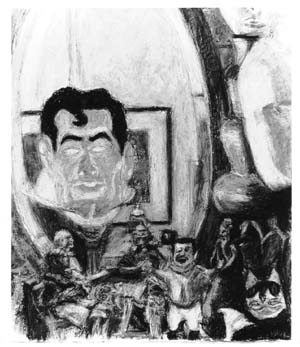 November
15, 1995 (3rd Viewing) To say that your pictures are imbued with shades
of lyrical nihilism may be misguided by subjective interpretation on my
part, a wonder-struck viewer who comes after the fact, but I am convinced
that your visions speak of a truth which most humans would rather side-step
than confront. Your pictures are realistic in the most profound sense of
the word, for they reflect the real truth about this thing called
life: isolation, lonelineness and death. And yet, at the same time, they
speak of the mysterious importance of our concrete existences. Walking
in and around your pictures, my feeling is that if the tonal qualities
of the ideas of Nietzsche and Cioran can be captured through image, then
you have marvelously succeeded in doing so through this metaphysical
picture-windows that mirror the intensively creative core of your vital
being. Wishing you much exaltation and torturous joy!
November
15, 1995 (3rd Viewing) To say that your pictures are imbued with shades
of lyrical nihilism may be misguided by subjective interpretation on my
part, a wonder-struck viewer who comes after the fact, but I am convinced
that your visions speak of a truth which most humans would rather side-step
than confront. Your pictures are realistic in the most profound sense of
the word, for they reflect the real truth about this thing called
life: isolation, lonelineness and death. And yet, at the same time, they
speak of the mysterious importance of our concrete existences. Walking
in and around your pictures, my feeling is that if the tonal qualities
of the ideas of Nietzsche and Cioran can be captured through image, then
you have marvelously succeeded in doing so through this metaphysical
picture-windows that mirror the intensively creative core of your vital
being. Wishing you much exaltation and torturous joy!
I don't print the signature because I never had the opportunity to contact
him/her. The name isn't in the telephone book so, if the author happens
to read these lines please unveil yourself. Get in touch. I'd love to know
who wrote it. WM
�
 Back to the index of the Vagabond
© Copyright 1997  William Markiewicz
Brought to you with the help of: PD